
💸 WTF Is urble — The App That Just Fired Your Bank (Runs on Midnight)
Once upon a time, you put money in a savings account and felt good about it. Your bank gave you interest, a plastic card, and a sense of adult achievement.
But here’s the plot twist nobody told you: that “money in your account” was never really yours.
When you deposit into a bank, you don’t “store” your money. You lend it to the bank. Your balance is just an IOU — a promise that they’ll give it back when you ask.
They use your cash to fund loans, buy assets, and chase yield while you get… what, 0.1% interest?
So yeah — the bank gets rich. You get decimals. urble says: “Nah. Let’s fix that.”
💥 The urble Shift: You Don’t Lend Your Money — You Own It
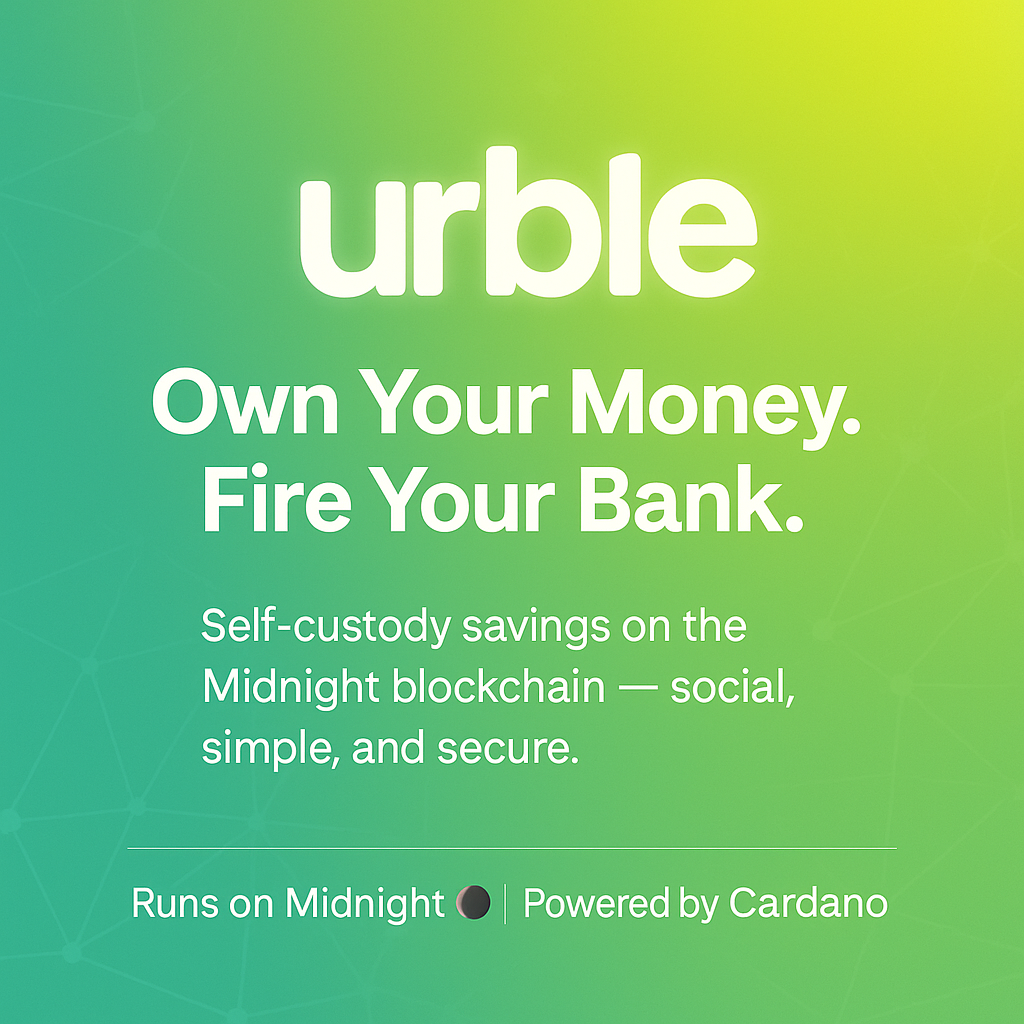
urble reimagines saving for the self-custody era. No IOUs, no middlemen, no “trust us, it’s insured.”
Instead, urble runs on the Midnight blockchain — where your balance isn’t a promise, it’s proof.
Every coin you see in urble exists on-chain.
You hold the keys, the smart contracts enforce the rules, and the app just makes it feel human.
It’s the first “social savings” wallet that actually lets you own what you save — together.
Imagine if Revolut, DeFi, and your family group chat had a baby — that’s urble. 👶💳
🏦 The Old Way: Banks, IOUs, and Broken Trust
- 💀 You’re a lender — not an owner. The bank owes you money, not the other way around.
- 🐢 Transfers take days and depend on legacy systems.
- 💸 Hidden fees eat away at savings.
- 🧾 Joint accounts require paperwork and legal gray zones.
- 🧊 Accounts can be frozen “for your safety.”
It’s the illusion of safety — your name on the screen, but your control outsourced.
And when something breaks (remember Credit Suisse 2023?), you realize “your money” lives on someone else’s balance sheet.
🧠 urble’s Way: Self-Custody, Smart Contracts, Social Finance
urble flips the logic: no deposits, no IOUs, no third-party risk.
You hold your assets directly on Midnight’s privacy-preserving blockchain.
Smart contracts — not humans — handle rules like savings schedules, payout conditions, or shared goals.
- 🔐 Self-Custody: You hold the keys. Always.
- ⚙️ Automation: Smart contracts move funds exactly how you define — save, split, or stake.
- 💬 Social Layer: Saving becomes collaborative — friends, godparents, or partners can co-save transparently.
- 🌍 Borderless: On Midnight, transfers are near-instant and private — no middlemen, no limits.
It’s money that feels alive — automatic, transparent, and shared — but without surrendering control.
👨👧 The Godfather Test: A Story of Lost Savings (and Second Chances)
25 years ago, a godfather saved money for his godchild in a bank account.
He deposited faithfully. When the kid turned 18, bureaucracy took over: forms, identity checks, waiting times.
By the time the dust settled, the money vanished somewhere between signatures and disinterest.
Fast forward to today — that godchild is now a godfather himself.
Only this time, he’s saving in ADA, BTC, and stablecoins through urble.
He sets a payout rule: “If my godchild doesn’t smoke before 18, they get 100%. Otherwise, half goes to a drug charity.”
That’s not a joke — that’s a programmable savings contract.
You can literally raise better habits through code. 🧠💨
🕹️ ELI18 Analogy: urble = Your Self-Driving Savings Account
Think of urble as a self-driving car for your money.
You tell it where to go (“save 100 ADA monthly, send half to godchild”), and it drives itself — safely, transparently, and automatically.
Except you still hold the keys. No one can take the wheel away.
It’s like TradFi automation, but without the bank behind the curtain.
🌑 Why It Runs on Midnight
Midnight is the privacy-focused sidechain of Cardano — think of it as the stealth layer for real-world financial apps.
It provides secure smart contracts, private transaction logic, and regulatory-friendly compliance hooks.
urble uses Midnight to balance two things most blockchains can’t: transparency for you, privacy from everyone else.
This makes it ideal for collaborative savings, shared goals, and intergenerational trust — all verifiable, all private.
⚔️ Comparison: urble vs Banks vs CeFi Apps
| Feature | urble (Midnight) | Traditional Bank | Crypto Exchange App |
|---|---|---|---|
| Ownership | You hold keys & assets | Bank holds your funds | Exchange holds custody |
| Transparency | On-chain, verifiable | Opaque balance sheet | Partial, trust-based |
| Privacy | Private smart contracts (Midnight) | Full KYC/visibility | Limited |
| Access | 24/7, global, borderless | Bank hours, local limits | Depends on platform |
| Fees | Minimal on-chain gas | Hidden & percentage-based | Exchange spread & withdrawal fees |
| Counterparty Risk | None (self-custody) | Full (bank solvency) | Medium (platform solvency) |
🌱 The Future: Money That Feels Human Again
urble isn’t just a savings app — it’s a philosophy:
money that’s owned, shared, and alive.
It bridges old habits (saving, gifting, building) with new logic (code, self-custody, privacy).
It’s how you’ll teach your kids, your friends, your DAOs — that ownership beats promises every time.
Because in the end, the coolest godparent isn’t the richest — it’s the one who saw the future coming and stacked ADA for it. 😉
🧩 TL;DR for Degens
- urble runs on Midnight — private, secure, smart-contract-powered saving.
- No IOUs. No banks. Just your assets, verifiable on-chain.
- Save solo or with friends. Add payout logic. Automate everything.
- Full control, zero middlemen, total transparency.
Read more:
WTF is Midnight & the NIGHT Token?
💬 Your Turn: Would you trust a bank less if you could actually own your savings?
Or better yet — what rule would you code into your urble wallet? Drop your wildest logic in the comments. 🧠💬
🧠 More About urble, Midnight & Self-Custody
Is urble a DeFi app or a savings tool?
Both. urble merges DeFi principles (self-custody, smart contracts, yield logic) with the simplicity of a savings app. It lets users automate saving, investing, and goal-based contributions directly on the Midnight blockchain, without banks or intermediaries.
How does urble use Midnight’s privacy features?
Midnight adds privacy to programmable finance. urble leverages Midnight’s confidential smart contracts — allowing shared saving goals and payout logic to run transparently for participants, yet stay private to outsiders. It’s like Midnight’s NIGHT airdrop — verifiable, but still confidential.
Is urble connected to the NIGHT token?
While urble isn’t a token project, it operates in the same Midnight ecosystem that powers the NIGHT token and Scavenger Mine. Future integrations could connect Midnight dApps for cross-utility between identity, savings, and privacy-enabled finance.
What makes urble different from traditional banking apps?
urble isn’t a custodian — it’s a facilitator. Unlike banks or CeFi apps, urble never touches your funds. You hold your own assets, set the conditions for how they’re used, and let smart contracts enforce them. It’s saving on autopilot — but with ownership.
What happens if urble or Brick Towers shuts down?
Nothing catastrophic. Your funds are on-chain and controlled by your private keys. You can recover them anytime using a compatible wallet. Even if the company disappears, your money remains yours — because urble is built on self-custody principles, not institutional promises.
Why does urble feel like a social app?
Because money has always been social. urble adds a collaborative layer where families, friends, and godparents can co-save, automate gifts, or create milestones together. It’s like Revolut Jars — but verifiable, programmable, and powered by smart contracts instead of bank servers.
Will urble integrate staking or yield features?
Yes. urble will allow users to allocate part of their savings to staking ADA or stablecoin yield opportunities — similar to how ZEIT delegators earn double rewards through Cardano staking. The returns are transparent, and you stay in control of your principal at all times.